. It is an
Cardiogenic shock remains associated with substantial mortality, typically 30–50%. Almost every patient with cardiogenic shock receives vasoactive medications, yet surprisingly little high-quality evidence tells us which drug to use, in which patient, and at what stage.
I spoke about this recently at EMCORE.
THE STUDY
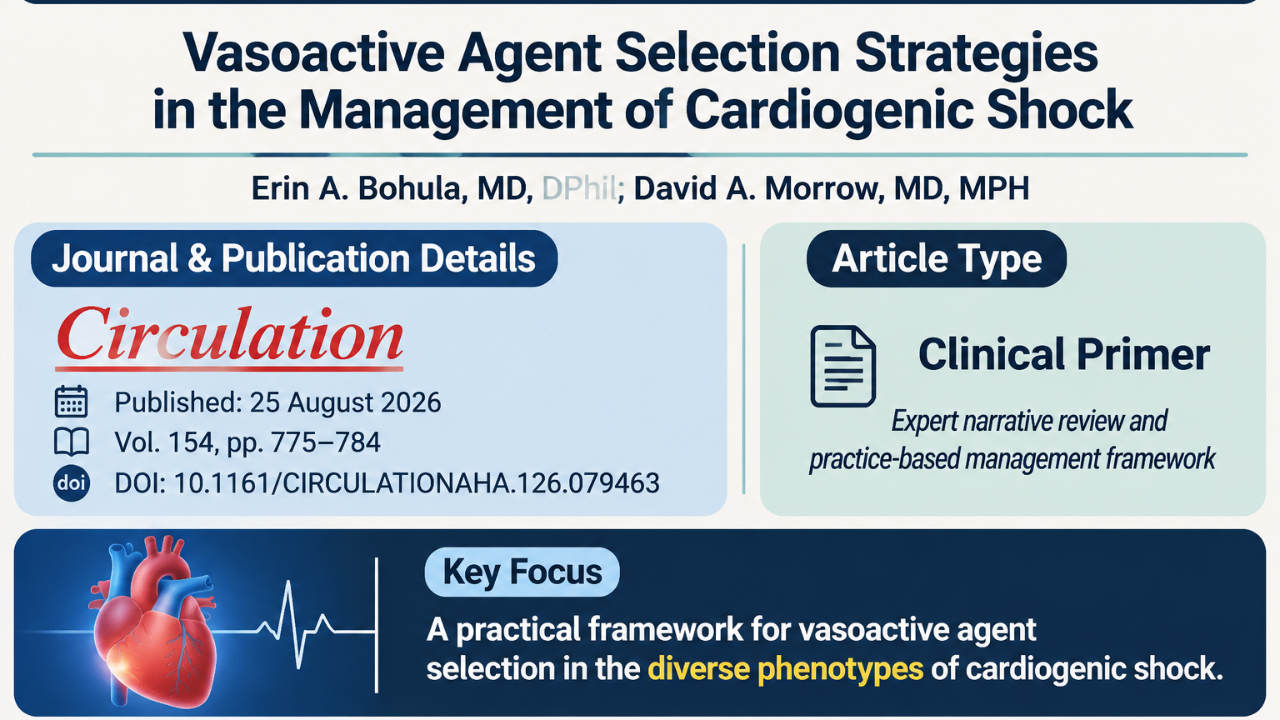
Erin A. Bohula and David A. Morrow. Circulation. 2026;154:775–784. Published 25 August 2026.
The Question
Should we choose vasoactive agents according to blood pressure, or according to the underlying haemodynamic phenotype? It's obvious that we need to move beyond just correcting hypotension.
The choice of vasoactive agent should reflect:
-
The underlying mechanism of shock.
-
The relative contributions of reduced cardiac output and abnormal vascular resistance.
-
Whether left or right ventricular dysfunction predominates.
-
The presence of hypoperfusion despite normal blood pressure.
-
The haemodynamic response to initial treatment.
Haemodynamic measurements are an important guide to what we do, however in emergency medicine, vasoactive support is frequently commenced before invasive haemodynamic measurements are available.
What they did
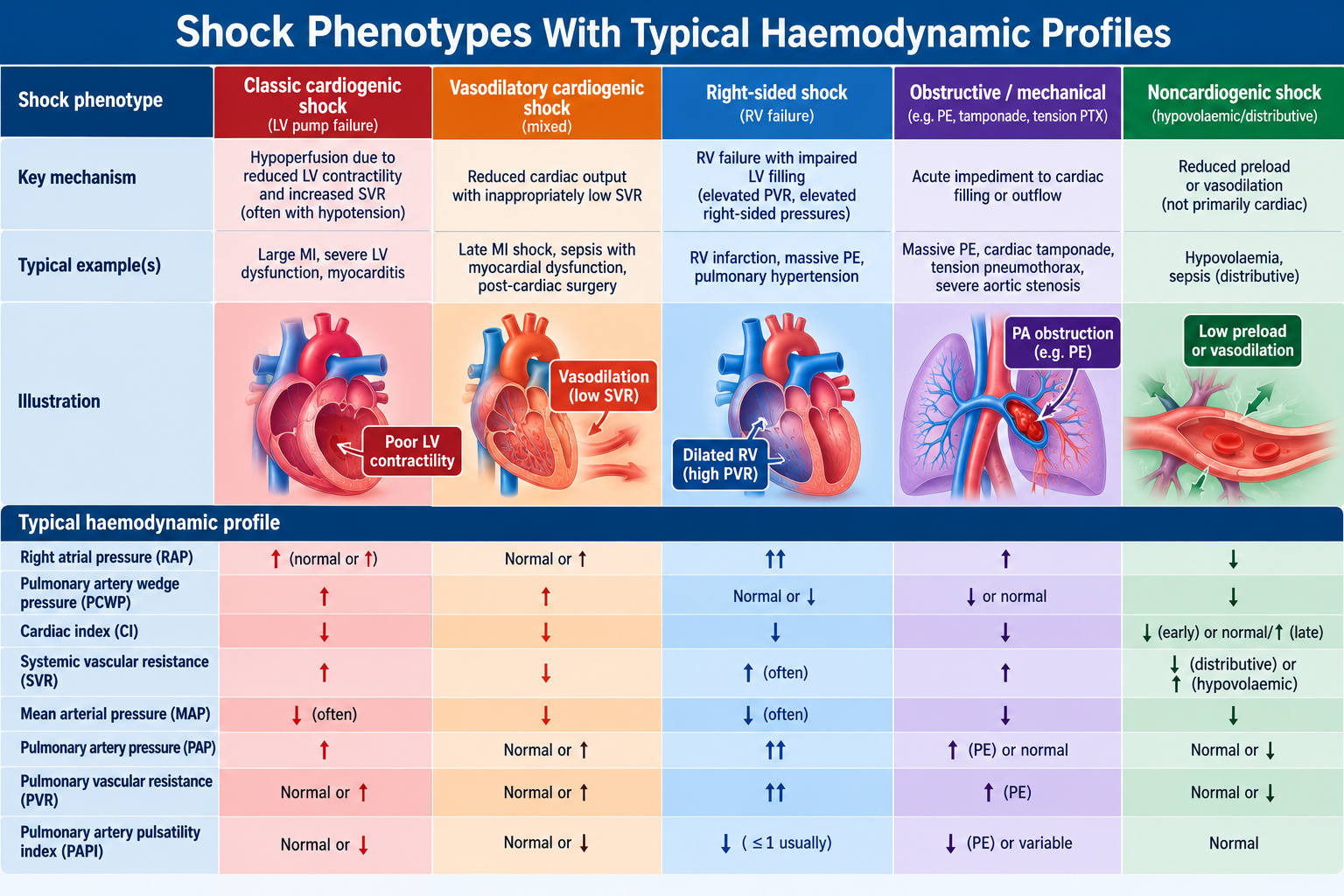
The authors reviewed the pharmacology of commonly used vasoactive agents, the limited randomized comparative evidence, and the haemodynamic characteristics of five important cardiogenic shock phenotypes.
They then proposed a four-step management framework.
Step 1: Protect the MAP
Restore adequate systemic perfusion pressure.
Step 2: Define the shock phenotype
Identify the haemodynamic abnormalities, underlying cause and reversible contributors.
Step 3: Set additional haemodynamic goals
Target cardiac output, filling pressures and vascular resistance.
Step 4: Reassess and tailor therapy
Adjust vasoactive agents according to ongoing hypoperfusion and haemodynamic response.
The proposed primary haemodynamic targets ( some of these are not obviously available in the emergency department) are:
|
Parameter
|
Target
|
|
MAP
|
65–75 mmHg
|
|
Cardiac index
|
≥2.2 L/min/m²
|
|
PCWP
|
14–18 mmHg
|
|
Right atrial pressure
|
5–10 mmHg
|
|
SVR
|
800–1,000 dyn·s/cm⁵
|
|
PAPI
|
>1.0
|
What are the Haemodynamic Profiles?
Management Strategy
Dopamine vs Noradrenaline
De Backer et al. NEJM, 2010
-
Population: 1,679 patients with shock, including 280 with cardiogenic shock.
-
Intervention: Dopamine versus noradrenaline.
-
Primary outcome: 28-day mortality.
|
Outcome
|
Dopamine
|
Noradrenaline
|
|
28-day mortality
|
52.5%
|
48.5%
|
|
Arrhythmias
|
24.1%
|
12.4%
|
Overall mortality was not significantly different (P=0.10), but arrhythmias were significantly more frequent with dopamine (P<0.001).
Noradrenaline is generally preferable to dopamine, particularly when tachyarrhythmias are a concern. Dopamine may still have a role where relative bradycardia contributes to shock.
Adrenaline versus noradrenaline — OptimaCC
Levy et al. JACC, 2018
-
Population: 57 patients with acute myocardial infarction-related cardiogenic shock and LVEF below 40%.
-
Intervention: Adrenaline versus noradrenaline.
-
Primary outcome: Change in cardiac index.
|
Outcome
|
Adrenaline
|
Noradrenaline
|
|
Refractory shock
|
37%
|
7%
|
|
Arrhythmias
|
41%
|
33%
|
|
60-day mortality
|
52%
|
37%
|
There was no significant difference in the primary cardiac-index outcome (P=0.43).
Refractory shock was significantly more frequent with adrenaline (P=0.01), but this was a post hoc outcome that included persistent lactate elevation, but can increase lactate independently of tissue hypoperfusion.
Therefore, an elevated lactate after commencing adrenaline does not necessarily indicate deteriorating cardiac output.
The study raises concerns about adrenaline, but its small sample and post hoc refractory-shock outcome limit definitive conclusions about comparative clinical outcomes.
Milrinone versus dobutamine — DOREMI
Mathew et al. NEJM, 2021
-
Population: 192 patients with cardiogenic shock.
-
Intervention: Milrinone versus dobutamine.
-
Primary outcome: Composite of death, cardiac arrest, transplantation or mechanical support, MI, stroke/TIA, or renal replacement therapy.
|
Outcome
|
Milrinone
|
Dobutamine
|
|
Primary composite
|
49%
|
54%
|
|
In-hospital mortality
|
37%
|
43%
|
The primary composite was not significantly different (RR 0.90; 95% CI 0.69–1.19; P=0.47).
Selection should depend on haemodynamics, renal function, arrhythmia risk and the need for rapid titration.
Vasopressin versus noradrenaline — VANCS
Hajjar et al. Anesthesiology, 2017
This study enrolled 300 patients with vasoplegic shock after cardiac surgery and preserved cardiac index, rather than established low-output cardiogenic shock.
The composite of mortality or severe complications occurred in 32% of the vasopressin group versus 49% of the noradrenaline group (P=0.0014).
However, 30-day mortality was similar.
These results support further investigation of vasopressin in vasoplegia, but cannot be directly extrapolated to typical cardiogenic shock.
Which vasoactive agent should we use?
The paper distinguishes three pharmacological categories.
|
Class
|
Drugs
|
Primary effects
|
|
Inopressors
|
Noradrenaline, adrenaline, dopamine
|
Increase cardiac output and SVR
|
|
Inodilators
|
Dobutamine, milrinone
|
Increase cardiac output, reduce SVR
|
|
Vasopressors
|
Vasopressin, phenylephrine
|
Increase vascular resistance without direct inotropy
|
Noradrenaline versus adrenaline
The authors suggest that adrenaline may offer physiological advantages in selected patients with hypotensive cardiogenic shock because it combines contractile support with less relative vasoconstriction. Noradrenaline has relatively greater α1 activity, producing more vasoconstriction, whereas adrenaline provides stronger β1-mediated cardiac stimulation.
They state that they sometimes prefer adrenaline to noradrenaline for this reason.
Their preference for adrenaline is based primarily on physiological reasoning, not demonstrated superiority in clinical outcomes.
Indeed, the OptimaCC trial raises potential safety concerns of Adrenaline, although the evidence remains insufficient to settle the question.
Dobutamine versus milrinone
|
Feature
|
Dobutamine
|
Milrinone
|
|
Mechanism
|
β1/β2 agonist
|
PDE-3 inhibitor
|
|
Inotropy
|
Increased
|
Increased
|
|
SVR
|
Decreased
|
Decreased
|
|
PVR
|
Decreased
|
Decreased
|
|
Half-life
|
Approximately 2 minutes
|
Approximately 2.5 hours
|
|
Renal impairment
|
Easier to titrate rapidly
|
Accumulation risk
|
|
Tachycardia
|
More problematic
|
Generally less
|
|
Pulmonary vasodilation
|
Present
|
Potentially greater
|
The authors tend to favour dobutamine early in shock because it can be titrated rapidly, and milrinone when pulmonary hypertension, troublesome tachyarrhythmias or prolonged inotropic support are important considerations.
Neither approach has been demonstrated to improve survival over the other.
The right ventricular shock patient
The authors identify three key goals:
-
Maintain systemic perfusion pressure and RV coronary perfusion.
-
Avoid increasing pulmonary vascular resistance.
-
Improve RV contractility when necessary.
Their suggested approach is to consider vasopressin first because it increases SVR with relatively little effect on PVR. If further support is required, adrenaline may be added for its inotropic effects.
They advise avoiding phenylephrine where possible because it may increase PVR and RV afterload.
They also emphasise correcting hypoxia, hypercarbia, acidosis, hypothermia and excessive positive end-expiratory pressure.
In selected patients without significant left-sided congestion, inhaled nitric oxide or prostacyclin may be considered to reduce PVR.
This is a coherent physiological approach, but there is no high-quality randomized evidence establishing vasopressin-first therapy as superior in RV-predominant cardiogenic shock.
Summary
1. Recognise shock despite normal BP. Tissue hypoperfusion is the defining feature, not hypotension alone.
2. Use noradrenaline as a reasonable default in undifferentiated hypotensive cardiogenic shock, while recognising that no agent has definitively established first-line superiority.
3. Consider adding an inodilator when MAP is restored but cardiac output remains inadequate, rather than simply escalating vasoconstriction.
4. Recognise RV-predominant shock early. Avoid unnecessary increases in PVR, consider vasopressin where appropriate, and tailor inotropic support.
5. MAP alone is not an adequate measure of successful resuscitation. Lactate trends, capillary refill, mental status, urine output, echocardiography and, where appropriate, invasive haemodynamics all contribute.